
Dermal Filler Filling Machine for Medical Aesthetics: Bubble Control and Dosage Accuracy
The medical aesthetics market includes a wide range of injectable products, including hyaluronic acid dermal fillers, collagen injectables, skin boosters, poly-L-lactic acid formulations, calcium hydroxyapatite gels, and other regenerative biomaterials. Although these products differ in composition and application, many share the same production challenge: high viscosity.
For manufacturers, choosing the right dermal filler filling machine is not simply a matter of selecting a pump and entering a filling volume. High-viscosity medical aesthetic products require coordinated control of product flow, air bubbles, dosing pressure, filling speed, and container closure.
A suitable medical aesthetic filling machine should be selected around the actual behavior of the formulation. Depending on the product and package format, the complete solution may include vacuum degassing, vacuum filling, servo-driven dosing pumps, a balanced liquid distributor, programmable filling curves, vacuum stoppering, or syringe plunger insertion.
Why Medical Aesthetic Products Are Difficult to Fill
Hyaluronic acid gels, collagen products, skin boosters, and microsphere-based injectables can have very different flow properties. Some formulations flow relatively easily, while others are highly resistant to movement through narrow pipes, manifolds, and filling needles.
This creates several challenges during production.
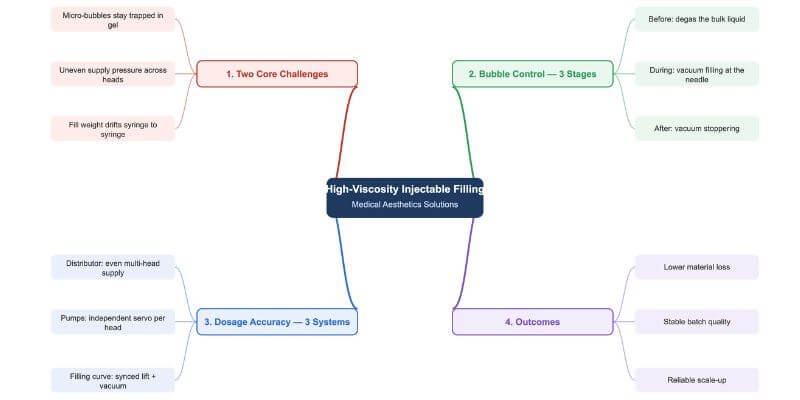
First, air bubbles may remain suspended in high-viscosity products. A thin liquid can release trapped air relatively easily, but micro-bubbles in an HA gel or dense dermal filler may remain in the product for a long time. If these bubbles enter a prefilled syringe or vial, they can affect the visual appearance, closure stability, and final injection experience.
Second, high-viscosity products do not always distribute evenly through a multi-head filling system. Pressure loss in small channels or uneven product supply may cause different filling heads to dispense different amounts.
Third, filling accuracy can change as product temperature, pressure, and flow resistance change. A high-viscosity filling machine therefore needs to control the complete product path instead of relying on one dosing component alone.
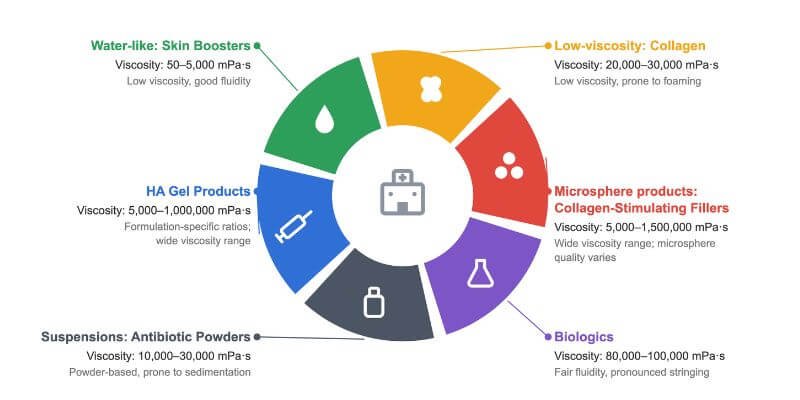
Choosing a Filling Machine for Medical Aesthetic Products
A filling machine for medical aesthetic products should be evaluated according to both the formulation and the primary packaging. Important factors include:
- Product viscosity and flowability
- Presence of microspheres or suspended particles
- Target filling volume or weight
- Syringe, vial, cartridge, or other container format
- Required number of filling heads
- Product sensitivity to shear and air
- Filling speed and output requirements
- Closure method after filling
- Cleaning and product changeover requirements
A hyaluronic acid filling machine may require a different pump configuration from a collagen filling machine. A skin booster filling machine designed for a relatively fluid formulation may not use the same filling curve, needle, or vacuum setting as a machine for dense CaHA or PLLA products.
For this reason, product samples, packaging drawings, and target filling specifications should be reviewed before the equipment configuration is finalized.
Three Stages of Bubble Control
Bubble control begins before the product reaches the filling nozzle and continues until the container is closed. A complete injectable filling machine should address all three stages.
1. Before Filling: Product Degassing
The first step is to reduce entrained air in the bulk product before dosing begins. Depending on the formulation, this may involve vacuum standing, vacuum mixing, or another controlled degassing method.
The correct method depends on the product’s viscosity, mixing behavior, and sensitivity to shear. HA gels, collagen products, and microsphere formulations may require different preparation conditions.
The objective is to allow the product to enter the filling area with as little trapped air as possible. Effective upstream degassing reduces the load placed on the vacuum filling system and helps improve the consistency of the finished product.
2. During Filling: Vacuum-Assisted Dosing
Vacuum filling creates a controlled negative-pressure environment around the container while the product is dispensed. This helps the product spread more smoothly and reduces the risk of air being pulled into the filling path.
For syringe filling, the movement of the filling needle and product must be coordinated carefully. For vial filling, the product should be deposited with minimal splashing or turbulence. The correct vacuum level, dosing speed, needle position, and needle-lift profile depend on the formulation and container geometry.
A vacuum-assisted HA gel filling machine can be useful when the product is dense, stringy, or difficult to distribute evenly inside the syringe or vial.
3. After Filling: Controlled Closure
The final stage is closing the container while minimizing trapped headspace air.
For vial-based products, this may involve vacuum stoppering before crimping. For prefilled syringes, the process may require controlled plunger insertion or another syringe closure method. The exact configuration depends on the primary packaging format.
A prefilled syringe filling machine should therefore be evaluated together with its plunger insertion and closure system, rather than as a filling unit alone.
Three Systems That Improve Dosage Accuracy
Accurate filling of medical aesthetic products depends on the coordination of three systems: product distribution, dosing pumps, and filling motion.
1. Liquid Distributor for Even Multi-Head Supply
A suitable liquid distributor should minimize pressure loss and provide balanced product flow to each filling head. Large flow channels and appropriately sized outlets can help high-viscosity products move through the system more smoothly.
Even distribution is especially important when several syringes or vials are filled simultaneously. If one filling head receives more product pressure than another, the final dosage may vary across the same batch.
For a multi-head dermal filler filling machine, the distributor design is just as important as the pump itself.
2. Independent Servo-Driven Filling Pumps
Independent servo control allows each filling pump to be adjusted separately. This provides additional control when different filling heads require fine calibration.
Pump selection should be matched to the product. An HA gel filling machine, collagen filling machine, and microsphere product filling machine may require different pump structures, filling speeds, and product-contact configurations.
The pump should also be selected with product shear, cleaning, and changeover requirements in mind. The right configuration depends on the actual formulation rather than the product name alone.
3. Programmable Filling Curves
The filling curve determines how the pump, filling needle, vacuum, and container movement work together.
For many high-viscosity injectable products, the needle should move gradually while the product is dispensed. This allows the gel to spread along the bottom of the syringe or vial instead of falling from a fixed height and creating turbulence.
Important filling curve parameters may include:
- Filling speed
- Vacuum timing
- Needle insertion depth
- Needle lifting speed
- End-of-dose cut-off
- Break-string control
- Delay before closure
A repeatable filling curve can be stored and reused for different medical aesthetic formulations. This helps reduce variation when the same injectable filling machine is used for several products.
Applications of a Medical Aesthetics Filling Line
A medical aesthetics filling line may be configured for a range of products and container formats, including:
- Hyaluronic acid dermal fillers
- Collagen injectable products
- Skin boosters and mesotherapy products
- PLLA or PDLLA microsphere formulations
- Calcium hydroxyapatite gels
- Regenerative injectable biomaterials
- Prefilled syringes
- Glass vials
- Cartridges and other custom containers
The final equipment configuration depends on product viscosity, dosage, container size, closure method, and target output.
A machine designed for water-like skin booster products may not be suitable for dense dermal fillers without changing the pump, nozzle, filling curve, or vacuum settings. For this reason, a medical aesthetics filling line should be engineered around a specific product family or a clearly defined range of formulations.
From Product Sample to Production Equipment
The most reliable equipment selection process starts with product and packaging testing.
Before choosing a medical aesthetic filling machine, the manufacturer should provide:
- Product sample or representative formulation
- Viscosity and flowability information
- Target filling volume or weight
- Syringe, vial, or cartridge drawings
- Product-contact material requirements
- Required production output
- Preferred closure method
- Cleaning and changeover expectations
During testing, the supplier can evaluate filling speed, pump configuration, needle size, vacuum settings, product distribution, and the final closure process.
This approach helps avoid choosing a standard filling machine that performs well with one product but creates bubbles, stringing, or dosage variation with another formulation.
What Manufacturers Should Ask Before Buying
When comparing a dermal filler filling machine supplier, do not only ask for the nominal filling speed. Ask how the supplier will address the complete filling process.
Important questions include:
- Can the supplier test the actual HA gel, collagen, or skin booster formulation?
- How will air bubbles be reduced before filling?
- Is vacuum filling available for the selected container?
- Are the filling pumps independently servo controlled?
- Can the filling curve be adjusted and saved for different products?
- How are different filling heads calibrated?
- Is the system suitable for syringes, vials, or both?
- How is product changeover and cleaning handled?
- Can the filling machine connect with stoppering, plunger insertion, capping, or inspection equipment?
- Can FAT, SAT, IQ, and OQ support be included in the project scope?
A complete answer to these questions is more useful than a single catalogue number. The correct injectable filling machine should be selected according to product behavior, container format, and the manufacturer’s actual production plan.
Medical Aesthetic Filling Solutions from Weida Hebo
Weida Hebo provides filling equipment and packaging solutions for pharmaceutical and medical aesthetics production. Our filling systems can be configured around product viscosity, filling volume, container type, dosing method, and production requirements.
For HA gels, collagen injectables, skin boosters, and other high-viscosity medical aesthetic products, the proposed solution may include product degassing, vacuum filling, servo-driven filling pumps, balanced product distribution, programmable filling curves, and controlled container closure.
The equipment is designed in accordance with GMP requirements. Product-contact materials, machine layout, testing scope, and validation documentation can be reviewed according to the project requirements. CE marking is available on request.
Share your product viscosity, target dosage, container drawing, and expected output with our engineers. We can recommend a suitable dermal filler filling machine, prefilled syringe filling machine, or complete medical aesthetics filling line for your project.
Contact Weida Hebo
TEL: +86 18015338619
Email: chinahebo1@gmail.com
