Vials are widely used for injectable medicines, including liquid formulations and sterile powders for injection. Although both products may use glass vials and share some downstream equipment, their filling processes are not interchangeable. Powder dosing depends on powder behavior and feeding consistency, while liquid filling depends on the formulation, dosing system, and product-contact path.
Choosing a vial filling machine is therefore not simply a matter of selecting a line speed. Manufacturers should consider the product, vial and closure, target dose, sterilization strategy, cleaning requirements, and the way the line connects with upstream and downstream equipment.
This guide compares the main differences between powder and liquid vial filling, explains key selection factors, and outlines the process-control questions to address before requesting a quotation.
1. Powder Vial Filling: Controlling Powder Flow and Dose
How powder filling works
A powder vial filling machine typically transfers powder from a hopper into each vial using a metering system. One common method is an auger screw: the screw rotates to deliver a controlled volume of powder into the vial. A servo drive can control the screw’s rotation, but repeatable rotation alone does not guarantee a consistent dose by weight.
The delivered mass can also be affected by powder properties and feeding conditions, including bulk density, flowability, particle characteristics, moisture, and how consistently powder enters the dosing area. The screw geometry and dosing settings therefore need to be matched to the actual formulation.
Why powder testing matters
Powder flow is not captured by a single simple measurement. The United States Pharmacopeia’s General Chapter <1174> Powder Flow, which became official on May 1, 2024, covers methods that include bulk-density-related tests, flow through an orifice, and shear-cell methods.[3] A 2023 review likewise describes powder behavior as multidimensional and notes that no single test fully characterizes every powder’s flow behavior.[4]
These tests can help characterize a powder, but they should not be treated as a substitute for a filling trial using the actual product. Before confirming a powder filling system, evaluate the target dose, powder behavior, dosing setup, and results across a representative run.
For injectable powders, the powder path and filling environment also need to be considered as part of the sterile manufacturing process—not as an isolated machine feature.
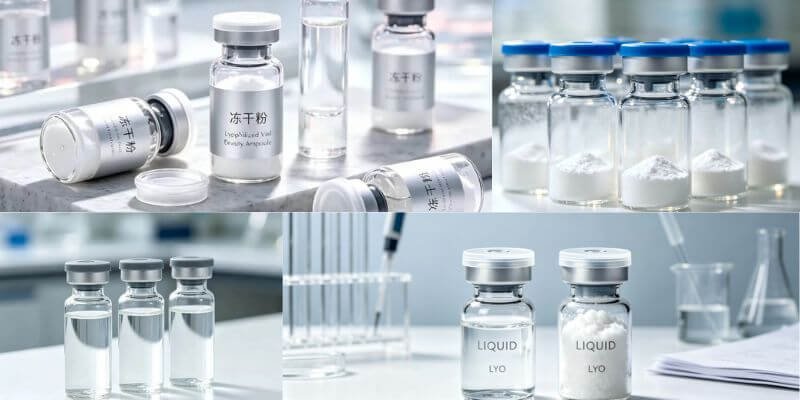
2. Liquid Vial Filling: Matching the Pump to the Formulation
Common liquid dosing approaches
Liquid vial filling systems may use different dosing principles. Two common options are:
- Piston pump: A piston displaces a defined volume of liquid. The suitable configuration depends on the formulation, target fill volume, equipment design, and required process controls.
- Peristaltic pump: Rollers compress flexible tubing to move the liquid. The product contacts the tubing rather than the pump body. If single-use tubing is specified and the process is appropriately controlled, this can reduce the number of reusable product-contact components—but the pump type alone does not guarantee sterility or eliminate cross-contamination risk.
Pump selection should be based on the actual product and process. Relevant factors include viscosity, foaming, particulates, sensitivity to shear, fill volume, tubing or wetted-part compatibility, and cleaning or sterilization requirements. Confirm performance with the intended formulation rather than relying on a pump label or a generic accuracy claim.
Vacuum or pressure-assisted filling may be considered for particular product-container combinations. However, negative pressure is not a sterilization method; sterility depends on the validated manufacturing process and its contamination controls.[1][2]
Liquid filling for lyophilized products
Some products intended for freeze-drying are filled as liquids and partially stoppered before transfer to a freeze dryer. This is a specific process configuration: the transfer route, stopper position, and protection of open or partially stoppered vials need to be addressed in the line design and the site’s validated process.[1, §8.20]
3. Powder vs. Liquid Vial Filling: Key Differences
| Comparison point | Powder vial filling | Liquid vial filling |
|---|---|---|
| Product form | Dry powder or granules | Liquid formulation |
| Typical dosing principle | Auger screw or another powder-metering system | Piston, peristaltic, or another product-specific dosing system |
| Main variables | Powder flow, bulk density, feeding consistency, screw geometry, target mass | Viscosity, foaming, particulates, fill volume, pump and product-contact path |
| Dose confirmation | Test with the actual powder and target fill weight | Test with the actual formulation and target fill volume |
| Common process concerns | Powder containment, dosing consistency, vial-mouth cleanliness | Dripping, splashing, foaming, product compatibility, and cleaning |
| Stoppering | Full or partial stoppering, depending on the product and process | Full stoppering or partial stoppering for selected lyophilization processes |
| Downstream operations | Stoppering, capping, inspection, and line transfer as specified | Stoppering, capping, inspection, and—where needed—transfer to freeze drying |
The two routes may share some vial preparation and closing equipment, but their dosing assemblies and process controls differ. A line should be designed around the intended product and validated process, rather than assuming that changing a filling head is enough to switch between powder and liquid.
4. Aseptic Processing, Stoppering, and Capping
Not every sterile product follows the same sterilization route. EU GMP Annex 1 states that, where possible, the finished product should be terminally sterilized using a validated and controlled process. Aseptic processing is relevant when terminal sterilization is not possible for the product.[1, §8.34] The U.S. FDA also provides guidance for sterile drug products manufactured by aseptic processing.[2]
For aseptically processed products, the design of the filling and closing sequence matters:
- Open primary containers: EU GMP Annex 1 says open primary packaging containers should be maintained under Grade A conditions with the appropriate background environment.[1, §8.20]
- Vial capping: Annex 1 allows capping of aseptically filled products either as an aseptic process using sterilized caps or as a clean process outside the aseptic area, subject to specified protections.[1, §8.27]
- Stopper position: Where capping is performed as a clean process with Grade A air protection, vials with missing or displaced stoppers should be rejected before capping; qualified automated stopper-height detection should be in place.[1, §8.28]
- Inspection: Annex 1 calls for individual inspection of filled parenteral containers for extraneous contamination or other defects.[1, §8.30]
One useful reference figure: Annex 1 Table 1 gives a Grade A cleanroom classification limit of 3,520 airborne particles per cubic metre at ≥0.5 μm, both “at rest” and “in operation.” This is a particle-classification value—not a microbial limit, proof of product sterility, or a machine performance specification.[1, Table 1]

5. How to Select a Vial Filling Machine
Before comparing machines or requesting a quotation, prepare the following information:
- Product type: sterile powder, liquid, suspension, or another formulation.
- Dose target: target fill weight for powders or target fill volume for liquids.
- Product properties: powder flow and bulk-density information, or liquid viscosity, foaming, particulates, and material compatibility.
- Vial and closure: vial dimensions, fill volume, stopper type, cap type, and required change parts.
- Production target: required output under the actual product and container conditions—not only the machine’s nominal speed.
- Sterilization and cleaning strategy: whether vials are ready-to-use or require washing and further processing; which product-contact components need cleaning or sterilization.
- Line integration: whether the project needs vial washing, a tunnel sterilizer oven, stoppering, capping, inspection, labeling, or a freeze-drying connection.
- Acceptance criteria: how filling performance will be tested, recorded, and accepted during product trials or FAT.
If one facility makes both powder and liquid products, do not assume that a standard filler can be switched between them without further engineering. Dedicated equipment may simplify process separation; a shared platform should be considered only after reviewing the product-contact design, cleaning/changeover strategy, contamination risks, and validation requirements.
6. Vial Filling Solutions from Weida Hebo
Weida Hebo provides equipment options for both powder and liquid vial filling. Depending on the project, the line may also include vial washing, tunnel processing, stoppering, capping, inspection, or other downstream equipment.
Explore the relevant equipment:
- Powder Vial Filling Machine
- Powder Vial Filling Line
- Liquid Vial Filling Machine
- Liquid Vial Filling Line
- Vertical Rotary Ultrasonic Bottle Washing Machine
- Tunnel Sterilizer Oven
The final configuration should be confirmed against the formulation, vial and closure, target dose, required output, and manufacturing process. Contact Weida Hebo to discuss a project.
Frequently Asked Questions
What is the main difference between a powder and liquid vial filling machine?
The dosing principle and process variables are different. Powder filling depends on powder feeding and flow characteristics, while liquid filling depends on the formulation and the selected pump or dosing system. Both require testing under the intended product and container conditions.
How is powder vial filling accuracy confirmed?
Characterize the powder and run filling trials using the actual formulation and target fill weight. Powder-flow tests can support equipment selection, but no single powder-flow test replaces a product-specific filling evaluation.
Does a peristaltic pump eliminate contamination risk?
No. The liquid contacts the tubing, not the pump body, but tubing selection, installation, sterilization or single-use status, and process controls still matter. The pump alone does not establish sterility.
Do all vial filling lines require Grade A conditions?
Grade A protection applies to critical operations in aseptic processing as specified by the applicable process and regulatory strategy. It is not a blanket specification for every machine or every product; the manufacturing site’s process design and contamination-control strategy determine the requirements.
Can a vial filling line connect to a freeze dryer?
It can be configured for selected lyophilized products, typically involving liquid filling, partial stoppering, and transfer to the freeze dryer. The transfer and protection strategy must be designed for the specific process.
Should powder and liquid products use separate filling machines?
Not in every possible project, but they should be treated as distinct process routes. A shared platform should not be assumed suitable without an engineering and contamination-control review, a validated changeover strategy, and confirmation that the configuration meets the product’s requirements.
References
- European Commission, EudraLex Volume 4, Annex 1: Manufacture of Sterile Medicinal Products (2022), including Table 1 and Sections 5.5, 8.20, 8.27–8.30, and 8.34. Official PDF
- U.S. FDA, Sterile Drug Products Produced by Aseptic Processing—Current Good Manufacturing Practice: Guidance for Industry (2004). FDA guidance page
- USP, General Chapter
<1174> Powder Flow. Official date: May 1, 2024. USP chapter information - Shah, D. S., et al. “A concise summary of powder processing methodologies for flow enhancement.” Heliyon, 9(6), e16498 (2023). Full text · DOI: 10.1016/j.heliyon.2023.e16498
